
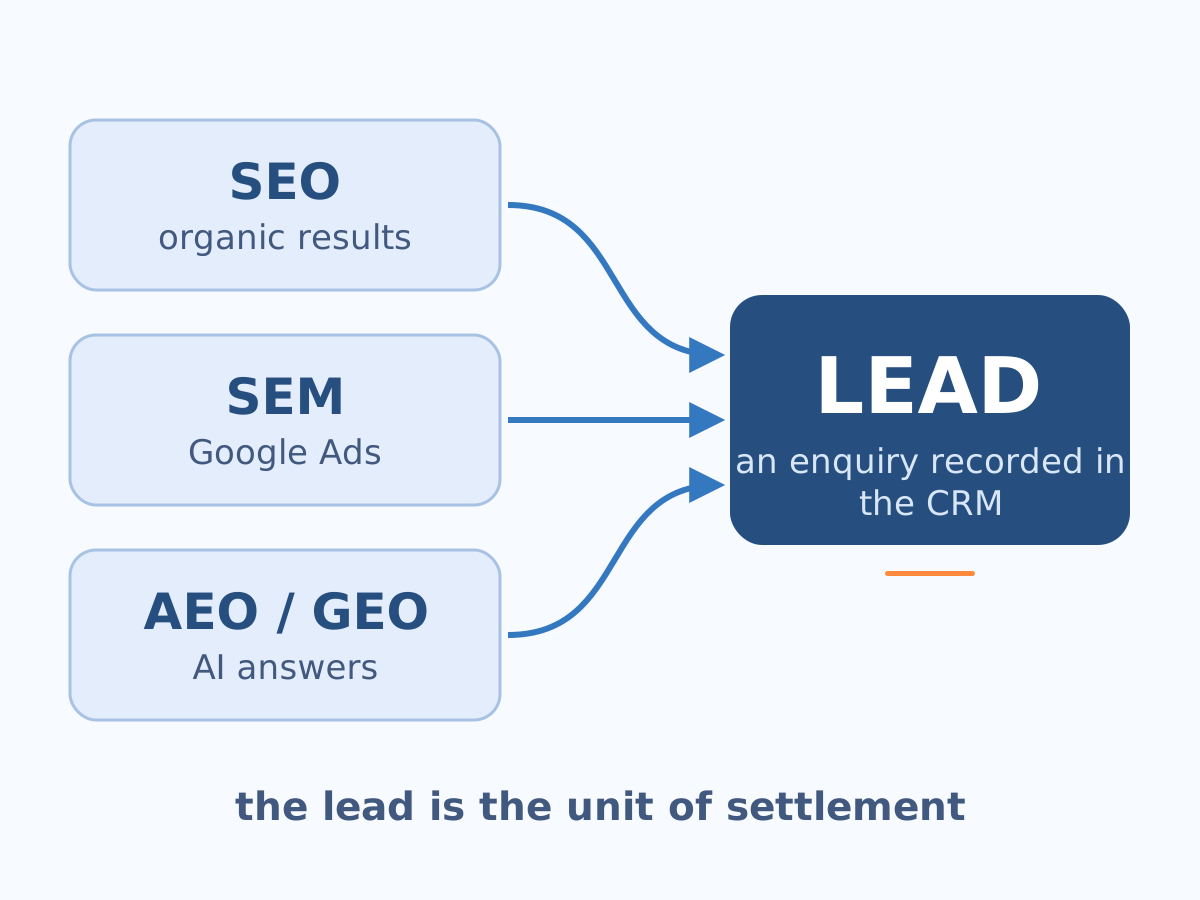
drySEO's services cover content designed for classic SEO and for AEO/GEO (Answer Engine Optimization / Generative Engine Optimization — the layer that decides whether a brand is named inside an AI-generated answer), Google Ads campaigns, and measurement that reconciles the ad panel with the CRM. Each of these parts exists so that commercial enquiries are produced and can be counted.
How do SEO, SEM and AI search fit into one service?
drySEO runs SEO, SEM and visibility in AI search as one service, planned around a single result: a commercial enquiry recorded in the CRM. Paid campaigns show within weeks which phrasings people actually convert on, and that knowledge goes into the organic content plan. How to split queries and budget between the channels is covered on the page about running SEO and SEM as one strategy.
Content designed for AEO/GEO and classic search
Companies receive complete topical hubs for their own site, built to be found by a search engine and quotable by an answer engine.
Topic architecture
A pillar page with its supporting pages, planned to cover the whole topic; the number of pages follows from that coverage, not from a plan fixed in advance.
Product and problem content
Builds authority in the subject: what the technology does, which constraint it removes, what it is compared against, what it costs a buyer to get the choice wrong.
Text structures readable by AI search
A heading that states a question, an opening sentence that answers it in full, self-contained sections, and evidence placed beside the claim.
Content for external publication
Expert articles and PR material designed for distribution and reputation, because a model reads mentions of a brand in other people's texts as well as the links pointing at it.
A separate deliverable, and often the one that changes the most: requirements for the client's own team. Marketing and webdev receive specifics — what to change, on which page, and how to verify it worked — written as tasks ready to schedule.
Google Ads and conversion tracking
Paid campaigns are run as the faster half of the same system, and conversion tracking is set up so that their main output, beyond leads, is evidence: which queries actually convert.
Campaign setup and optimization
Google Ads account structure, bids and ongoing optimization.
Matching to intent
Keywords and messages matched to intent, with buying-intent queries separated from research queries.
Requirements for the webdev team
Conversion tracking set up and described so that what the ad panel counts can be reconciled with what the CRM counts.
Consistent reporting
Results shown from the perspective of leads and pipeline, with every figure carrying its definition.
That last item carries the most weight, because the ad panel and the CRM count the enquiries from one campaign differently.
How is an SEO agency billed in B2B?
In B2B an SEO agency is billed in one of three ways — a retainer, payment for results, or payment per lead — and the three differ less in price than in which side carries the risk that the work never turns into a commercial enquiry.
On a retainer you buy a scope and working time for a fixed monthly fee, regardless of the result. This model funds work that pays back only after months — topic architecture, content, technical fixes — and at the start of a project it is often the only form in which such work can be ordered at all. The risk stays entirely with the buyer: the invoice describes what was done and says nothing about whether the funnel delivered an enquiry.
When you pay for results, you pay for a level of visibility reached, most often for a keyword's position in search results. The risk moves to the supplier, but the goal moves with it: the measure stops being a commercial enquiry and becomes an intermediate state. A keyword without buying intent is cheaper to rank for than a keyword on which someone buys, so the model rewards choosing easy keywords. A position that has been paid for and settled can sit beside an empty inbox.
When you pay per lead, the unit is a commercial enquiry, so the supplier is paid only when the buyer gets what they came for. The price of that unit is derived from two of the buyer's figures — order value and the share of enquiries that end in an order — not from an hourly rate card.
This model sets one condition the other two do not: both sides have to count the same way. The ad panel and the CRM report different numbers for the same period, and the direction of that difference is constant — the panel sees less. That is why, in per-lead billing, the first thing agreed is not the price but the definition: what counts as a commercial enquiry, what is discarded as noise, and which system holds the binding number. Without that one clause in the contract, each side settles a different quantity.
How the work is billed: the lead is the unit
Our product is a lead, so the lead is the unit of settlement. External costs — advertising budget and developer time — you pay directly to the supplier, which keeps the cost of the medium visibly separate from the cost of the work on the system.
The price of a lead comes from arithmetic. It is derived from two figures established at the start: an estimate of the market value of an order, and the share of leads that close into an order.
The calculation runs on your numbers, not on sample ones. Order value times margin gives the profit on one closed order; that profit times the close rate — the share of leads that end in an order — gives the expected profit on one lead before that lead is bought. The price you pay has to sit far enough below that figure for a real part of that profit to stay with you.
Two decisions in this calculation make the biggest difference. The first: we calculate from your margin, not from revenue, because margin is what repays the cost of the lead — the same arithmetic run on revenue produces a ceiling several times too high and a deal that looks affordable while losing money.
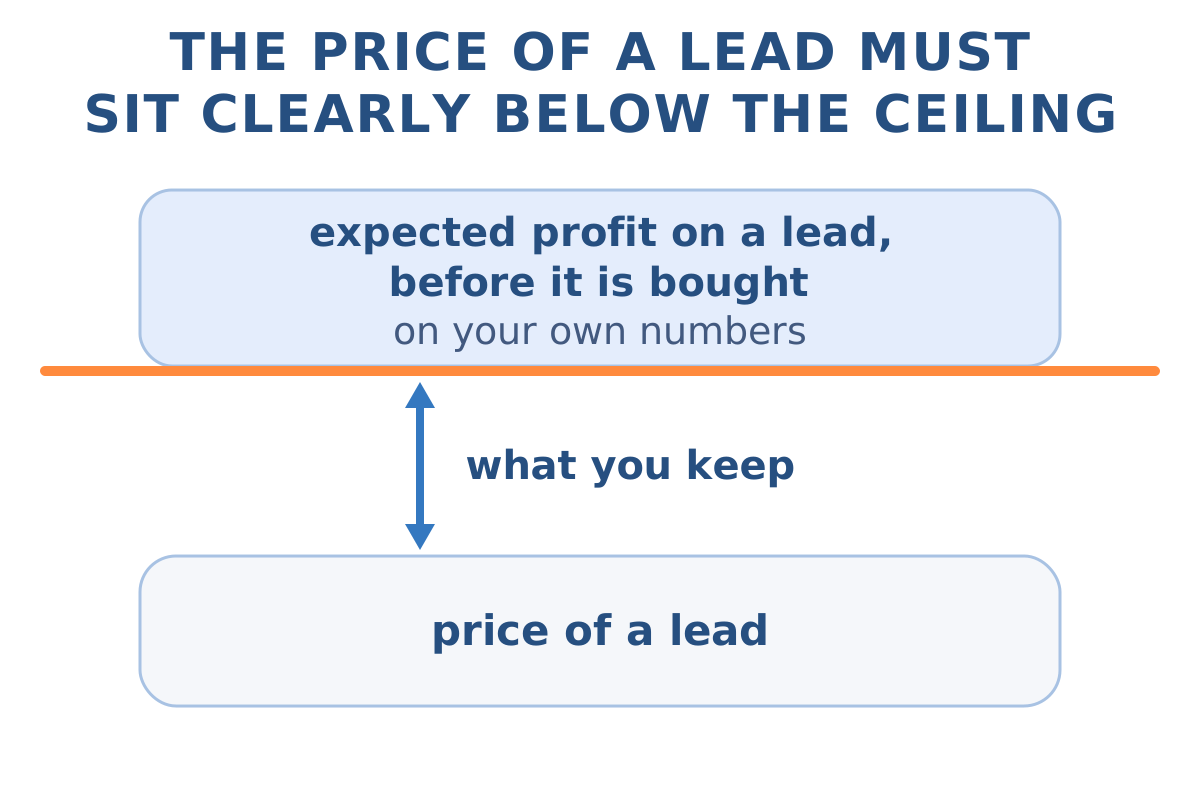
The second: we calculate on the weakest close rate we have seen, 5–6% (drySEO lab data, directional from practice — orders divided by commercial enquiries, on the markets furthest from the client's core business). What comes out for you comes out of your own numbers, which is why the conversation starts with them.
Close rate depends on market more than most calculations assume. That 5–6% is the weakest scenario; across the whole drySEO funnel the same measure is 13.6% (range 11.6–15.0% depending on the denominator; drySEO lab data, full-year measurement). The value of the same lead can therefore differ about two and a half times, depending on where it was acquired. That is one of the reasons we derive the price of a lead from numbers — and set it separately for each market you enter.
We calculate on the worst-case scenario because the settlement model has to hold even when a market turns out harder than assumed. The denominators behind these numbers are set out in our cost-per-lead guide.
What the free diagnosis answers
A project starts with a diagnosis that answers four questions:
- what an order is worth on your market, and what share of enquiries closes into a sale today;
- where demand is leaking — in the content, the authority, the landing page or the measurement;
- what can be improved in the first weeks, and what needs a quarter;
- who on your side will take over the system once it is running.
We run the diagnosis for the companies we work with — technology businesses selling B2B and B2G on international markets. It is free, and its output stays with you: a map of your own funnel and a list of the numbers still needed before that funnel can be compared over time.
Who drySEO works with
drySEO specialises in B2B and B2G, and particularly in lead generation for high-technology companies, defence among them, selling a complex, expensive product into a long decision cycle on demanding export markets. Content for these companies demands a specific approach and a long apprenticeship in the subject matter — the reader is an engineer or a technical buyer, the claims have to survive their scrutiny, and the purchase involves a committee rather than a single person. drySEO has run SEO and SEM campaigns on major international markets; a full year of one such programme is counted source by source in the case study.
Two consequences shape the work. The buying cycle is long, so the content has to hold a prospect across months of research before a first enquiry arrives. And the qualifying detail is technical, so the pages that generate enquiries are usually the ones that state specifications, limits and comparisons plainly.
SEO and SEM for technology and manufacturing companies
Visibility and content quality are the condition for the trust in a brand that brings a technical buyer to an enquiry.
Outsourced lead generation, in drySEO's case, means producing SEO content for technical products, written for a technical B2B and B2G reader and for building trust in Google's AI Mode. Combined with Google Ads, it speeds up building the brand both at home and on foreign markets.
B2B
Two sectors in which a lead is an enquiry about a technical solution, and the decision on the buyer's side is made by a team rather than one person:
- Leads for technology companies — Why the first reader to convince is the engineer evaluating the product rather than the budget holder, and what follows for content.
- Leads in sales to industry and public institutions — How the route to the engineer who finds you differs from the route to the people who sign off the purchase.
B2C
Two consumer markets where the same principles work with a different audience:
- Leads for real estate agencies — What to do with an enquiry when the client can transact only once and the decision can stretch over months.
- Leads for law firms — How a search for legal help becomes an enquiry that reaches a named person in the practice while the problem is still pressing.
How a project runs
Four steps, in this order:
Diagnosis
Where demand leaks today in search: content, authority, landing page, measurement, or paid campaigns.
Plan
Strategy, priorities, topic architecture, schedule, and the definitions every metric will be reported under.
Production
Content to the AEO/GEO standard; webdev implements the recommendations on the site; campaigns go live in parallel.
Measurement and iteration
A report saying what is growing, what is holding flat, why, and what changes next.
What we build with you is a lead generation system — strategy, content, campaigns, measurement — and it is handed over to your team with documentation and procedures. Before hiring a lead generation specialist, it is worth owning the machine they will operate.
How we run the engagement
The engagement runs on two lists of duties agreed at the start: strategy, content, campaigns and measurement sit with us, while implementation on the site, product knowledge and decisions on scope sit with you. Every item carries a named owner and a date, so at any moment it is clear whose move comes next.
What the work needs from your side
Three things set the pace: access to the systems holding the evidence (analytics, CRM, ad panel, the site itself), developer time to implement the requirements we write, and a product expert who answers technical questions, since the qualifying detail in technical content comes from them. We also agree three roles on your side at the start — who approves content, who publishes it, and who signs off a stage. In B2B these are usually three different people, and naming them early is what keeps the schedule in check.
The working rhythm
Work runs in short cycles: a prioritised task list at the start of each one, and a report at the end in which every figure is counted under the definition agreed in the plan. Tasks and submissions sit on one board of stages, so a build-up at any stage is visible while it is still a queue, before it turns into a quarter's delay. One channel carries the communication, and decisions land in the same task list the developer works from.
Handover
Each stage closes with an acceptance: what was produced, what went live, what the measurement showed, and what enters the next cycle. At the end your team receives the system together with its documentation and procedures — topic architecture, content templates, metric definitions and the tracking configuration — in a form your own people can keep running.
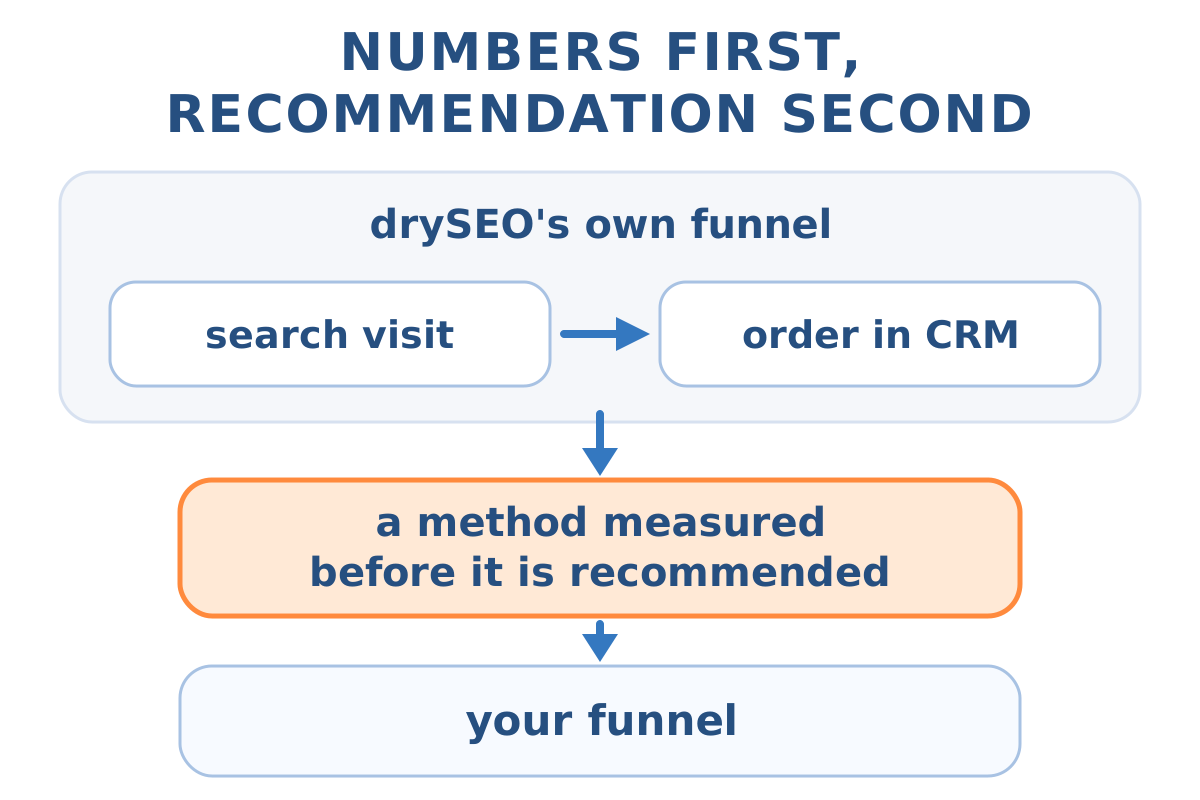
Every figure in a cycle report carries its denominator, just as in the measurements we run on our own funnel before recommending a method. You can see what was divided by what, run the same count on your own funnel, and compare one quarter with the next.
What does AI search change in our work and offer?
AI search changes where the return on our work shows up, not its foundation: AI answers are assembled from the same index that organic results are ranked from, so a page a search engine cannot crawl, parse and trust will not make it into a generated answer either. On informational queries the payoff moves from the click to a brand mention, while on queries with buying intent the click and the lead remain — which is why we design content for both forms of visibility and check brand mentions on a fixed set of AI prompts. How we run brand visibility in AI answers as a separate channel with its own measurement is covered in our AI SEO guide.
In what order do the results of an engagement appear?
The first results of an engagement come from paid campaigns — enquiries, and evidence of which queries convert — while topic pages, brand mentions in AI answers and organic enquiries arrive only on a foundation of technical housekeeping and topic architecture. Two conditions decide whether that order holds: implementation speed on the client's side, and whether the measurement definitions were agreed before the work started. The full answer to how long it takes before SEO starts generating leads, together with the factors that move that date, is on the page about leads from search.
Frequently asked questions
Is Google Ads SEO or SEM?
Google Ads is SEM — paid search advertising. SEO covers the organic results underneath the ads. The two share the same query data, which is the practical reason for running them under one plan.
What services does a search engine marketing provider offer?
In this case: topic architecture and content built for organic and AI search, external publication material, Google Ads setup and optimization, requirements for conversion tracking, and reporting expressed in leads and pipeline. The output is a system your team can take over.
How do I choose a search engine marketing partner?
Ask how they define a lead, which denominator their cost-per-lead uses, and how they will reconcile the ad panel with your CRM. Precise answers to those three produce reports whose numbers stay comparable from quarter to quarter, which is the property that makes a report worth acting on.
How do you measure success?
On leads and pipeline, with every metric carrying its definition. Rankings, impressions and clicks serve as diagnostics along the way, while leads and pipeline are the result.
Who implements the changes on the site?
Your developers, working from specific requirements we supply: what to change, on which page, and how to verify it worked. Where a team is missing, the developer cost is paid directly to the supplier, so the cost of implementation stays visible and separate.