
With lead generation outsourcing, an outside team brings in and qualifies commercial enquiries for you, and answers for the result it was hired to deliver. The company keeps its sales team on closing; the supplier keeps the top of the funnel filled and answers for what arrives there.
The distinction that matters sits in that second sentence. Buying a campaign, a set of articles or a landing page is buying a task. Outsourcing lead generation is handing over an outcome — an agreed volume of enquiries at an agreed standard — and the settlement follows the enquiry rather than the hours spent producing it. This page covers what changes hands, how the work is measured, how it is paid for, and where the legal duty sits.
What is lead generation outsourcing?
When you outsource lead generation, the supplier takes over the whole chain — choosing who to reach, the channels, the content, the campaigns, capturing contacts and the first round of qualification — and hands you enquiries ready for a sales conversation. The internal team receives contacts with a stated qualification standard and a stated source, and spends its time on the conversation rather than on the search. The aim is to keep the sales funnel supplied continuously and predictably.
What is delegated is wider than it first appears, and the width is what makes the arrangement work. A supplier handling only campaigns inherits whatever the site, the content and the measurement already are, and those three decide how many of the clicks become enquiries. A supplier handling the whole chain can repair the weakest link instead of paying around it. The chain itself, end to end, is mapped in our guide to B2B lead generation.
Who carries the result?
The supplier carries it. In an outsourcing arrangement the external team commits to a defined number of enquiries at a defined standard, and the arrangement is judged against that commitment. That single clause separates outsourcing from task-buying, and it moves most of the execution risk off the client.
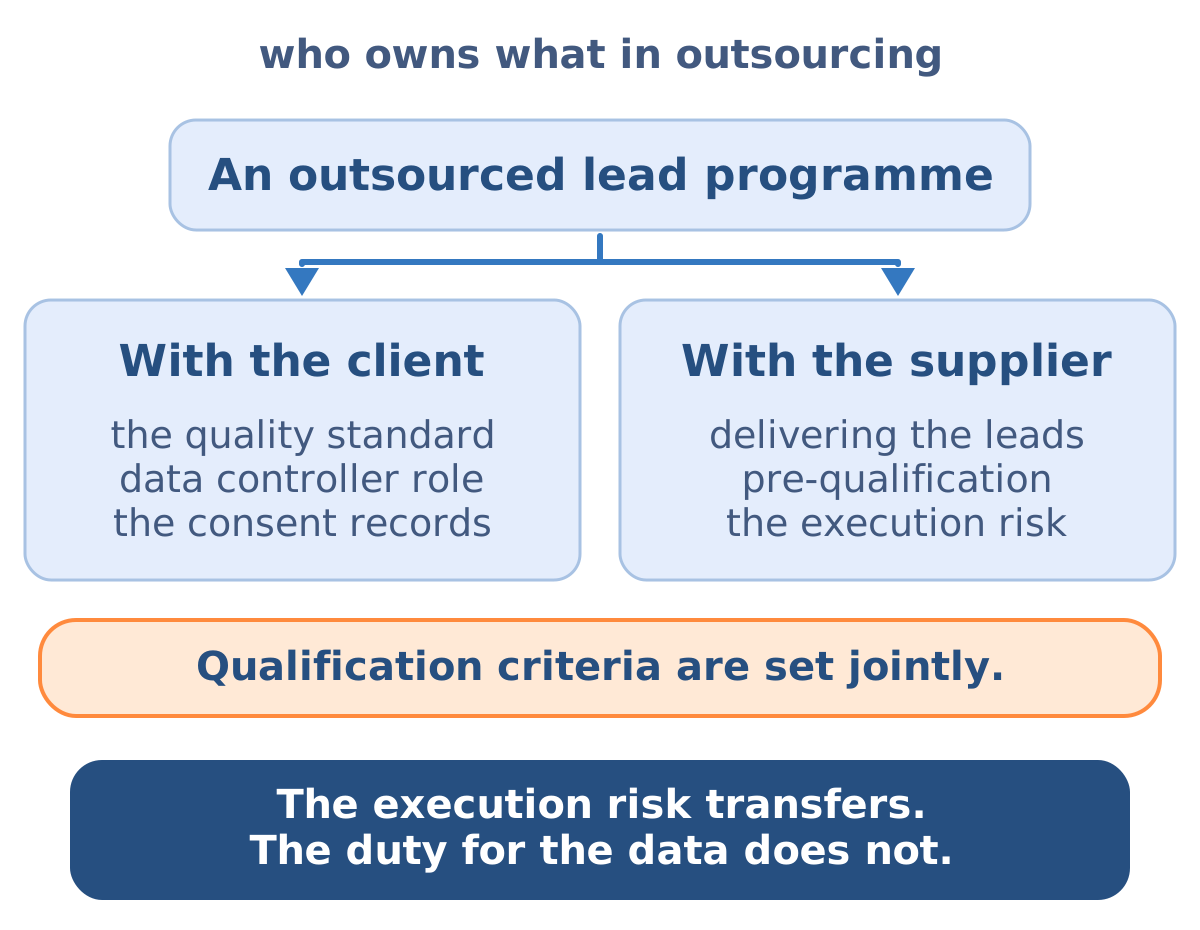
Carrying the result has a practical consequence that is worth stating plainly: the supplier chooses the methods. A commitment to an outcome with a prescribed method attached is a commitment to effort, since the supplier can deliver the prescribed method exactly and still produce nothing. The client sets the standard — which companies count as a fit, which enquiries count as workable — and the supplier sets the route to it.
The standard itself has to be written down before the first campaign runs, because it is the term the whole arrangement is settled against. What goes into that definition — fit criteria, behaviour criteria, the handover point between marketing and sales — is set out in the lead qualification guide.
Which methods does an outsourced programme run on?
An outsourced programme runs on the methods that produce enquiries with consent, which in B2B is a short list dominated by search. The contract describes the methods and the supplier chooses them; the client sets the standard and the scope of consent, so that the whole process stays transparent and compliant with the GDPR.
Paid search with purpose-built landing pages
the fast half, which starts producing within days and returns evidence about which phrasing converts.
Content and topical architecture on the client's own site
the durable half, which keeps producing after the budget stops and which is the only asset the client keeps.
Search visibility including AI answers
the same work extended to the surface where a generated answer names some suppliers and omits others.
Lead magnets
the material a reader exchanges contact details for, and the point where interest becomes a record.
Reviews and the company's own profile in search
the layer a buyer checks after he has found the company and before he writes.
Direct outreach by telephone and cold email sits at the other end of the list. It produces enquiries less well, and the consent question is answered by the client as data controller rather than by the supplier. In the laboratory's practice its product is a meeting booked for a salesperson, not an enquiry sent through a form. It belongs in the arrangement when the target population is small enough to name, and it belongs in the contract wherever it is used.
Which of these carries the weight depends on the market and the product. The organic half of the list, which is the part that compounds, is described in our B2B SEO guide.
Where does qualification happen?
Qualification happens on the supplier's side, before the contact reaches the client's sales team. The supplier scores each enquiry against the agreed standard and passes on the ones that meet it, so the sales team opens its day with a list of conversations worth having and can concentrate on closing deals. The client pays for the result, not for the effort.
Two things make this work rather than merely sound efficient. The scoring rules are written jointly, so the supplier filters on the client's definition of a good fit rather than on a generic one. And the rejected contacts stay visible to both sides, because a filter nobody can audit is a filter that quietly drifts toward whatever is easiest to deliver.
Once the enquiry crosses to the sales team, ownership, statuses and response times decide what happens next, and those belong to the client's own system — covered in our lead management guide.
How is an outsourced programme settled?
Per delivered enquiry, not per hour of work: the supplier is paid for enquiries that meet the standard written down before the first campaign, the same term the whole outsourcing arrangement is judged against. The alternatives are a fixed fee for a defined scope of work and a success fee, in which the agency's pay depends wholly or partly on the result; the three models differ above all in which side carries the risk.
How the price of one delivered enquiry is set is covered on the services page.
Which numbers show whether an outsourced programme pays?
Four numbers settle it, and each of them is meaningful only with its denominator attached.
CPL (cost per lead)
the cost of one contact; it says what the top of the funnel costs and lets you judge efficiency at an early stage.
CAC (customer acquisition cost)
the total marketing and sales cost needed to win one paying customer; this is the figure the business actually spends.
CVR (conversion between stages)
the share of leads that move on to the next stage, for example from MQL to SQL or from SQL to a closed deal; it shows where the funnel leaks.
ROAS (return on ad spend)
revenue from each unit of currency spent on paid campaigns; together with the share of enquiries from each channel, it suggests where the next unit of budget goes.
The denominator warning earns its place, and the laboratory's own account shows the size of the error it prevents. The same spend on the same markets produces cost-per-lead figures 6.2× apart, depending on whether the denominator is every lead from those markets, only the leads carrying a campaign parameter, or the conversions the advertising panel counted (drySEO lab data). A supplier and a client comparing two such figures are comparing two different questions.
The second error runs in one direction only. Enquiries carrying a campaign parameter in the CRM, set against the conversions the advertising panel reports, give a ratio of 1.4–1.9× — the panel always sees fewer (denominator: campaign-parameter leads in the CRM ÷ panel conversions; a control from a third system agreed within 0.4 percentage points; drySEO lab data). A programme judged on panel numbers alone is judged on its lower bound, and it can be switched off precisely when it is paying for itself.
How each of these figures is built up, channel by channel, is set out in the cost guide.
Who is responsible for personal data and consent (GDPR)?
The client is responsible. As data controller the commissioning company answers for how personal data in the programme is collected, stored and used, including any breach of the regulations, and that duty stays with it whoever runs the campaigns. Verifying that the supplier processes data lawfully is therefore part of the client's own compliance, written into the contract rather than assumed from it.
Three clauses carry most of that duty in practice: where consent is recorded and how it can be produced on request, which parties process the data and under what instruction, and what happens to the records when the arrangement ends. Keeping consent in the client's own system, from the first enquiry onward, is the arrangement that survives a change of supplier intact.
Build the team or outsource the system?
Both routes work, and the choice follows from what the company wants to own at the end. Building the team buys long-term control and institutional knowledge, at the cost of recruitment, training, salaries, tooling and the months before the first enquiry arrives. Outsourcing buys a working system now, with the method and the measurement supplied alongside it, turns the fixed cost of a team into a variable cost and leaves the company its time for its core business.
A third option sits between them and often suits technology companies well: outsource the build, then take delivery of it. The supplier assembles the system — content architecture, campaigns, tracking, reporting definitions — and hands it over with documentation, so the internal hire operates a machine that already runs rather than building one from a job description. What such a hire should own, and when the hire is worth making, is best settled before the contract is signed rather than after. Both questions are taken apart on the page about whether to hire a lead generation specialist or build a system.