
SEM SEO lead generation is the practice of running paid search and organic search as a single system that produces commercial enquiries, with one set of definitions underneath both halves. The paid half buys attention today and returns evidence within weeks; the organic half earns attention that keeps arriving after the spend stops. Run as one system, each half tells the other what to do next.
This page covers the join: what the two halves exchange, how the budget is allocated between them, how to keep them out of each other's way on the same query, and what the measurement looks like when both are counted the same way. The execution of each half separately belongs elsewhere — the organic side to our B2B SEO guide and the paid side to B2B Google Ads: Paid Search for Lead Generation.
What is SEM SEO lead generation?
SEM SEO lead generation treats search as one acquisition channel with two settlement models. The same buyer, asking the same question, meets the company either in a sponsored result or in an organic one; which of the two he meets depends on the budget, the ranking and the hour of the day, and the enquiry that follows arrives in the same form either way.
Three properties follow from running them as one channel.
The feedback loops differ in speed, and that is the point
Paid campaigns answer the question “which phrasing produces an enquiry” in weeks. Organic work answers “which topic produces an enquiry at no media cost” over quarters. A company running both gets the fast answer and the durable asset from the same keyword research.
The costs behave differently under pressure
Paid search scales with the budget and stops with it. Organic search accumulates: the work done in one quarter keeps paying in the next, and a technical fault keeps costing until it is repaired.
The measurement has to span both
A buyer frequently arrives through one half and converts through the other. Counting them in separate reports produces two channels that each look modest and a total that nobody owns.
What does running SEO and SEM together change?
Running both halves changes four things at once, and each of them shows up in the enquiry count rather than in the traffic count.
Coverage of the result page
Appearing in the sponsored block and in the organic listing for the same query occupies more of the screen and collects clicks that the single appearance would have lost. The effect is strongest on queries where the buyer is comparing suppliers and scanning for a name he recognises.
Coverage of the buying journey
Early questions — what the technology is, which constraint it removes, how it is compared — are answered by content that ranks organically. Late questions, where the buyer already knows what he wants to buy, are met by a campaign pointed straight at a landing page. One company covers both ends when both halves run.
Trust transferred in one direction
A buyer who has read the explanatory article and then sees the advertisement treats the advertisement as a shortcut to a supplier he has already evaluated. The organic asset does the convincing; the paid placement does the catching.
One message in both places
The headline that wins the click in an advertisement, the heading on the organic result and the first line of the landing page say the same thing, so the buyer who crosses between them keeps reading rather than re-orienting.
How does paid search data shorten the organic plan?
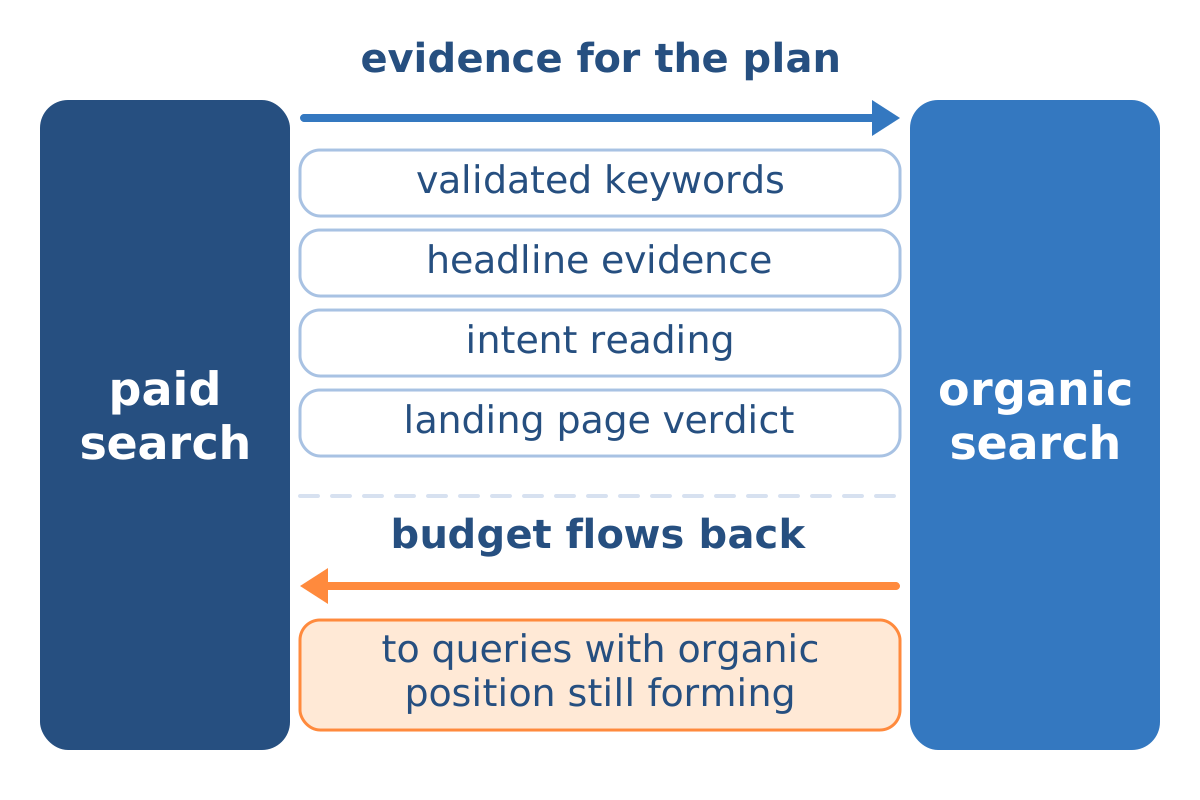
Paid search data shortens the organic plan by replacing a quarter of speculation with a few weeks of evidence. Four exchanges carry most of that value.
- Keyword validation. A campaign shows within weeks which queries produce enquiries and which produce visits, so the organic content plan starts from a shortlist that has already converted rather than from a volume estimate.
- Headline evidence. Click-through on advertisement variants shows which phrasing earns the click, and that phrasing goes into page titles and meta descriptions, where it earns clicks at no media cost.
- Intent reading. Query reports separate the research vocabulary from the buying vocabulary, which decides what each page should do: explain, compare, or ask for the enquiry.
- Landing page evidence. A page tested under paid traffic reaches a verdict in days. The version that wins becomes the template for the organic pages that answer the same question.
The exchange runs the other way too, and it is the half that saves money. Queries where the organic result already holds a stable top position deliver enquiries without media cost, so the budget pointed at them can move to queries where the organic position is still being built. The arithmetic behind that reallocation — what a contact costs in each channel and under which denominator — is set out in our cost-per-lead guide.
Where does the keyword planner stop being enough?
All four exchanges start from a campaign that is already running. Before one exists, the usual starting point is Google Ads Keyword Planner, which returns search volumes, forecast costs and related phrases for a chosen market. It is the right tool for the first draft of a plan and the wrong one for the version a budget is committed against, for three reasons that bite harder in a business market than elsewhere.
It reports demand grouped and rounded
Close variants are reported together and small volumes arrive in wide bands — which is the range most technical B2B phrases sit in. A phrase that brings a handful of enquiries a year can be indistinguishable there from one that brings none.
It reports demand, not what demand did
Volume says how often something is typed. The search-terms report of a live campaign says what was typed and what it produced, next to each other, and that pairing is what an organic plan is short of.
It reports the markets it is asked about
That limit costs the most, because the map of markets carrying a budget is not the map of markets that ask. On one B2B account, advertising reached 22 countries, commercial enquiries arrived from 185, and organic traffic from 243 (denominator: countries counted separately for ad spend, for enquiries in the CRM and for organic entries; drySEO lab data). An organic plan built from planner volumes for the markets that already carry spend is scoped to the smallest of those three maps.
So the planner sets the first shortlist and the campaign replaces it. The strings nobody thought to ask the planner about are the ones an organic plan was missing, and they surface only once real queries start being recorded.
How do you keep SEO and SEM out of each other's way?
You keep them apart by allocating queries deliberately rather than letting both halves bid for everything. Three situations cover most of the overlap, and each has a settled answer.
| Situation | Allocation |
|---|---|
| Both halves chase the same query | Buying-intent queries go to the campaign, research and brand queries to the organic pages; for contested brand queries both halves stay on, as a defensive position |
| The organic result already holds position one or two | Budget on that query moves to queries where the organic position is still being earned |
| The landing experience differs between halves | One page, one promise, one call to action, used by both halves |
The defensive case deserves a sentence of its own, because it looks like waste and behaves like insurance. On a brand query where a rival bids, the sponsored slot above the organic result belongs to whoever pays for it, and the cheapest way to keep a buyer who is already searching by name is to occupy both positions.
What does the measurement say when both halves are counted together?
Measurement says that the channel labels on a report depend on the denominator more than most teams expect, which is why both halves are reconciled against one source of truth before any budget decision is made.
The sharpest illustration comes from the laboratory's own account. Cost per lead from paid search can be stated as three different figures from the same spend on the same markets, and the spread between the lowest and the highest is 6.2× — the difference being whether the denominator is every lead from those markets, only the leads carrying a campaign parameter, or the conversions the advertising panel counted (drySEO lab data). The figure is true in all three readings and useful in none of them until the denominator is named.
The same account shows where the panel's reading sits relative to the system that holds the orders: enquiries carrying a campaign parameter in the CRM against conversions reported by the panel give a ratio of 1.4–1.9×, always in the same direction — the panel sees fewer (denominator: campaign-parameter leads in the CRM ÷ panel conversions; a control from a third system agreed within 0.4 percentage points; drySEO lab data). A company that judges the paid half on panel numbers alone is working from a floor, and treating that floor as the ceiling is what produces the decision to cut a campaign that was paying.
The metric definitions that make this reconciliation repeatable are set out in the lead generation metrics guide.
Which half of search closes better?
Both halves close, at rates close enough that the budget question stays open on close rate alone. Measured on a single form, with the channel read from the campaign parameter, enquiries arriving through paid search closed at 15.25% and enquiries arriving through organic search at 11.82% — a ratio of 1.29×, statistically significant at p ≈ 0.014 (denominator: orders ÷ commercial enquiries from the same form; the reference group excludes the direct pool, which closes at 25.55% and consists largely of returning customers; drySEO lab data).
Read carefully, that number argues for keeping both. A 1.29× difference in close rate is smaller than the cost difference between the two halves, so the organic half remains the cheaper source of orders even while the paid half converts a little harder. The direct pool closing at 25.55% points at the same conclusion from the third side: the strongest enquiries come from buyers who already know the name, which is what the organic half spends its quarters building.
What do the two teams have to share?
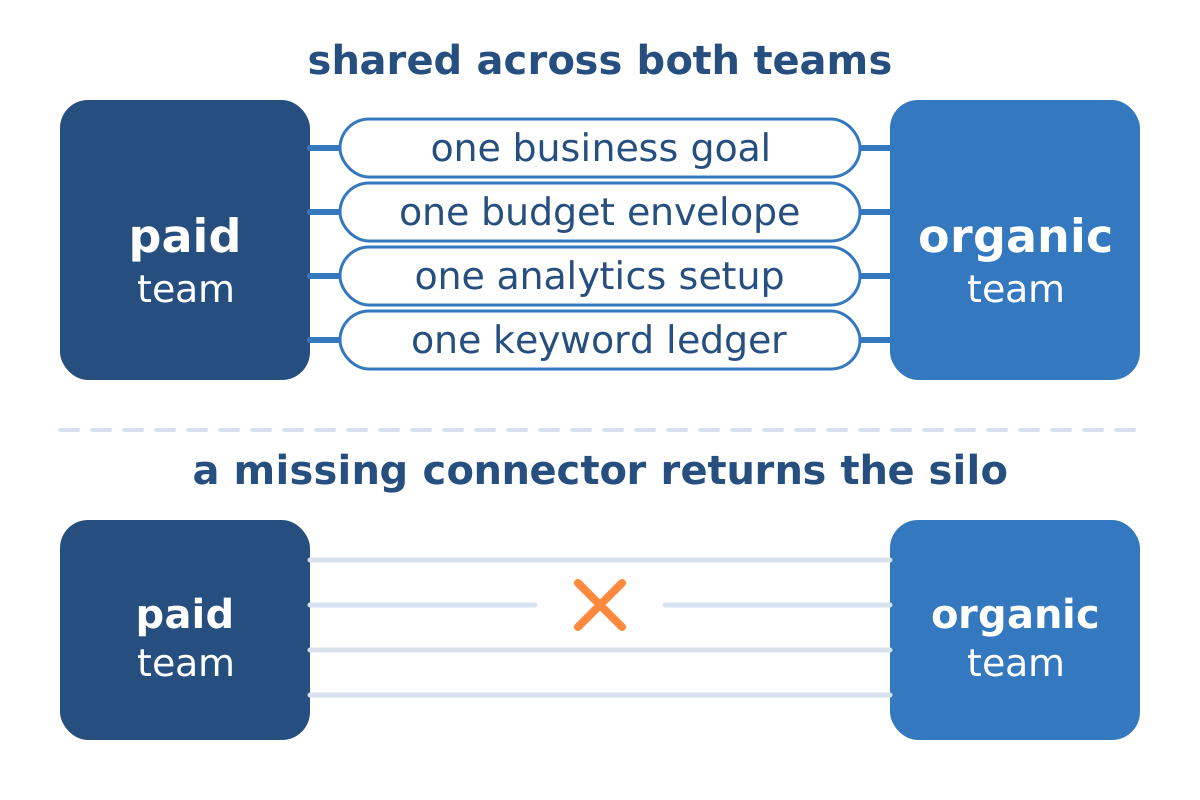
Two teams produce one system when they share four things: the goal, the budget, the analytics and the keyword ledger. A shared goal means enquiries and orders from search as a whole, rather than rankings on one side and return on advertising on the other; a shared envelope means money can move to whichever half currently returns more per enquiry; shared analytics means a visit, an enquiry and an order are counted once under one definition.
The shared ledger is where most of the practical conflict gets resolved, because it makes overlap visible while it is still a line item instead of an argument about budget. How enquiries are then routed, owned and followed up once they arrive is covered in our lead management guide.
How is the combined work measured?
The combined work is measured on five figures, each read across both halves rather than per channel.
Total enquiries from search, paid and organic together, which is the number the system exists to move. Close rate by channel, which says where the quality sits. Cost per enquiry with a stated denominator, which is the only form in which the figure can be compared across quarters. The organic share of enquiries over time, which shows whether the durable asset is taking over from the budget. And the share of enquiries the panel never sees, which is the correction factor between the advertising report and the orders.
Reported together, these five answer the question a board actually asks: what did search cost, and what did it bring. Assembling that reporting — content, campaigns, tracking and the definitions underneath them — is the work described in our SEO and SEM services.
What would have happened without the advertising?
Those five figures say what the system produced. They do not say what it added, and the two are different questions. An enquiry credited to a campaign may be an enquiry that would have arrived through the organic result an hour later; no report built on attribution separates the two, because attribution records the path an enquiry took, not the path it would have taken.
The size of the question shows in how far the credited share moves between markets. On one B2B account, advertising supplied 6% of the home market's leads and 43% of the leads from the largest export market (denominator: leads of a market carrying a campaign parameter ÷ all leads of that market, one year; drySEO lab data). Read as a verdict on advertising, the pair contradicts itself. Read as what it is, it says that the credited share depends on how much organic presence already stood in that market — and in neither market is it the quantity of enquiries the spend caused.
That quantity comes from an experiment rather than from a report. Google Ads runs the comparison as a campaign experiment: part of the traffic for one campaign is served by a variant while the rest keeps the current setting, and both arms are read on the same conversion definition over the same window. Where the question is whether the spend is needed at all rather than which setting is better, the arms are markets instead of settings — the campaign runs in one and is held back in the other, and the difference in enquiries is the answer.
Two conditions decide whether that works in a business market. The experiment is read on enquiries rather than on clicks, because clicks move first and say nothing about who was going to buy. And it runs long enough for small query volumes to produce a difference larger than the week-to-week noise, which here is a matter of months. No incrementality figure appears on this site: the numbers published here come from accounts measured as they ran, not from arms withheld for comparison.
How is the AI layer changing the join between the two halves?
The AI layer changes the join by adding a third surface where the same query gets answered, this time by a generated passage that names some suppliers and omits others. The paid half still buys placement around that answer; the organic half supplies the material the answer is assembled from.
The practical consequence is that the organic half acquires a second job. A page now has to rank and to be quotable: a heading that asks the question, an opening sentence that answers it completely, evidence standing beside the claim. What that requires technically, and how the resulting visibility is measured, is covered in our AI SEO guide.