
AI SEO: Brand Visibility in AI Search
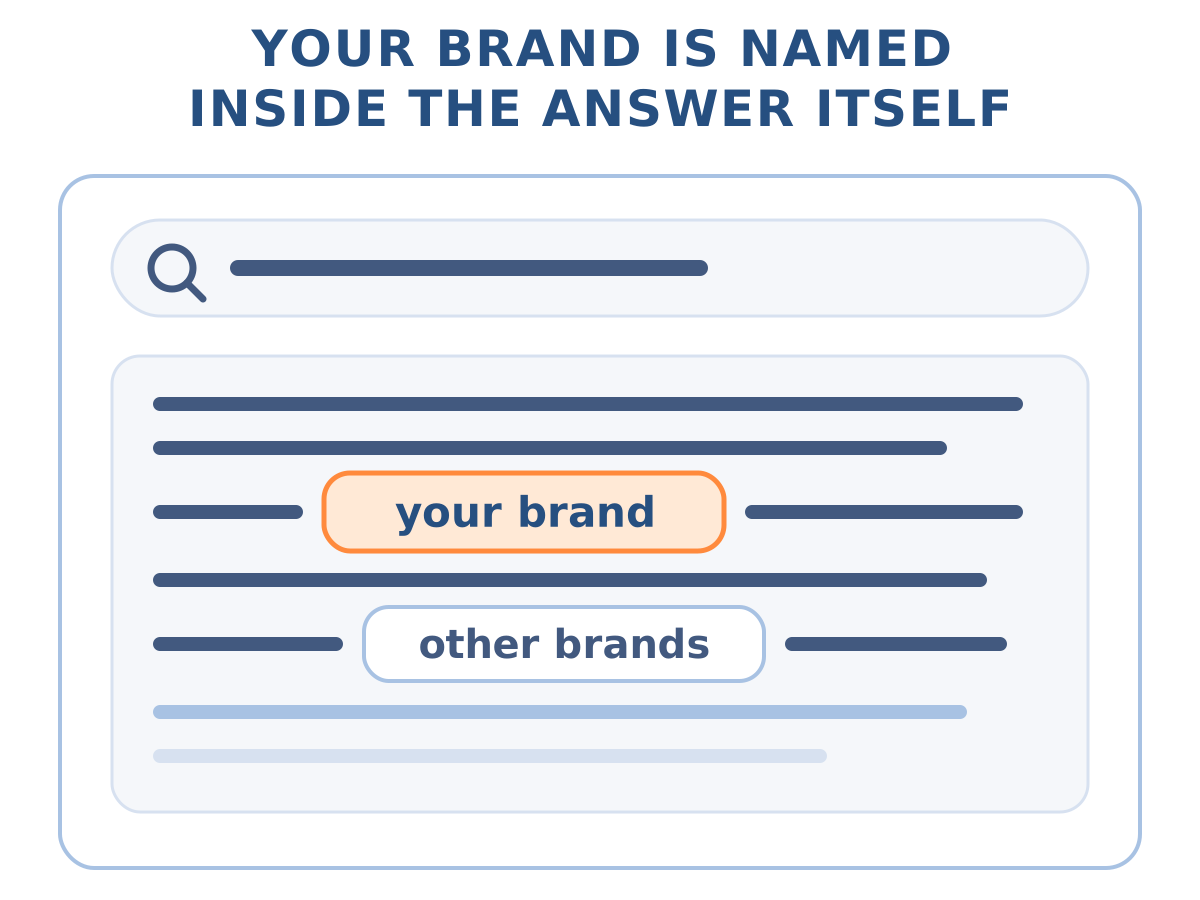
AI SEO is the work of getting a language model — Google AI Overviews, the AI mode in search, ChatGPT, Perplexity or Gemini — to name your company inside the answer it generates for a user. The reference point stops being a position on a list of ten links and becomes presence inside the one answer the user reads instead of that list.
This changes the mechanics of search in three places. First, the query no longer reaches the index in a single form: the engine breaks it into a dozen or several dozen sub-queries asked in parallel (query fan-out) and assembles the answer from their results. Second, what enters the answer is a fragment of a page, not a page — the model quotes the paragraph, list or table that answers a sub-query on its own. Third, the user often ends the session on the answer and clicks nowhere.
For a B2B company the practical conclusion is this: visibility in AI is a separate channel that needs its own work, but it settles against the same outcome as everything else — B2B lead generation.
What is AI SEO called now: GEO, AEO and LLMO
Four names are in circulation for one phenomenon, and it is worth knowing where each comes from, because in a conversation with a supplier the difference is sometimes purely a matter of marketing.
AI SEO
the broadest and most common name. It covers both visibility inside AI answers and the use of AI tools to do classic SEO work. Those are two entirely different things under one label, and most of the confusion in the category starts there.
GEO (Generative Engine Optimization)
optimization for generative engines, that is, for an answer assembled by a model.
AEO (Answer Engine Optimization)
optimization for an “answer engine”. The term is older; it comes from the era of featured snippets and voice assistants, and today it is used interchangeably with GEO.
LLMO (Large Language Model Optimization)
the rarest of the four; it puts the emphasis on the model itself as the addressee of the content.
The practical distance between GEO and AEO is small. The real dividing line runs elsewhere — between optimizing to be cited by a model and using AI as a tool to produce content. The first is a visibility strategy; the second is a way of working. A company buying “AI SEO” should know which of the two it is getting, because the deliverables, the timeline and the way the work is measured have almost nothing in common.
One more consequence of the naming: search engines index the words people use. If your category writes GEO and your page says only AI SEO, the page competes for a narrower term cloud than it could. Covering the terminology is not a stylistic decision — it is coverage.
What AI SEO changes against traditional SEO, and what it leaves untouched
The foundation stays untouched: crawlability, a sensible site architecture, speed, correct headings, consistent entities. The answer model draws on the same index and the same quality signals as the classic results — a page a search engine cannot process has nothing to be cited from.
What changes is the unit of success and the unit of content.
| traditional SEO | AI SEO (GEO/AEO) | |
|---|---|---|
| unit of success | rank of a URL and a click | a brand mention inside the answer |
| unit of content | a page | a fragment that answers one sub-query |
| trust signal | links and domain authority | consistency of brand facts across the web, citability of the fragment |
| measurement | rankings, impressions, clicks | presence in answers to a fixed prompt set, referrals from AI engines |
The most consequential shift concerns links. In the classic model, links voted. A language model also reads plain mentions — sentences about a brand with no link attached, in other people's articles, roundups and community threads. A mention without a link, which until recently counted for nothing, now does work.
The second shift is temporal. A classic ranking moves slowly and holds. An answer is regenerated on every query, so presence in it is a distribution, not a position — which is exactly why it has to be sampled repeatedly rather than checked once.
Two games: a mention on informational queries, a click on commercial ones
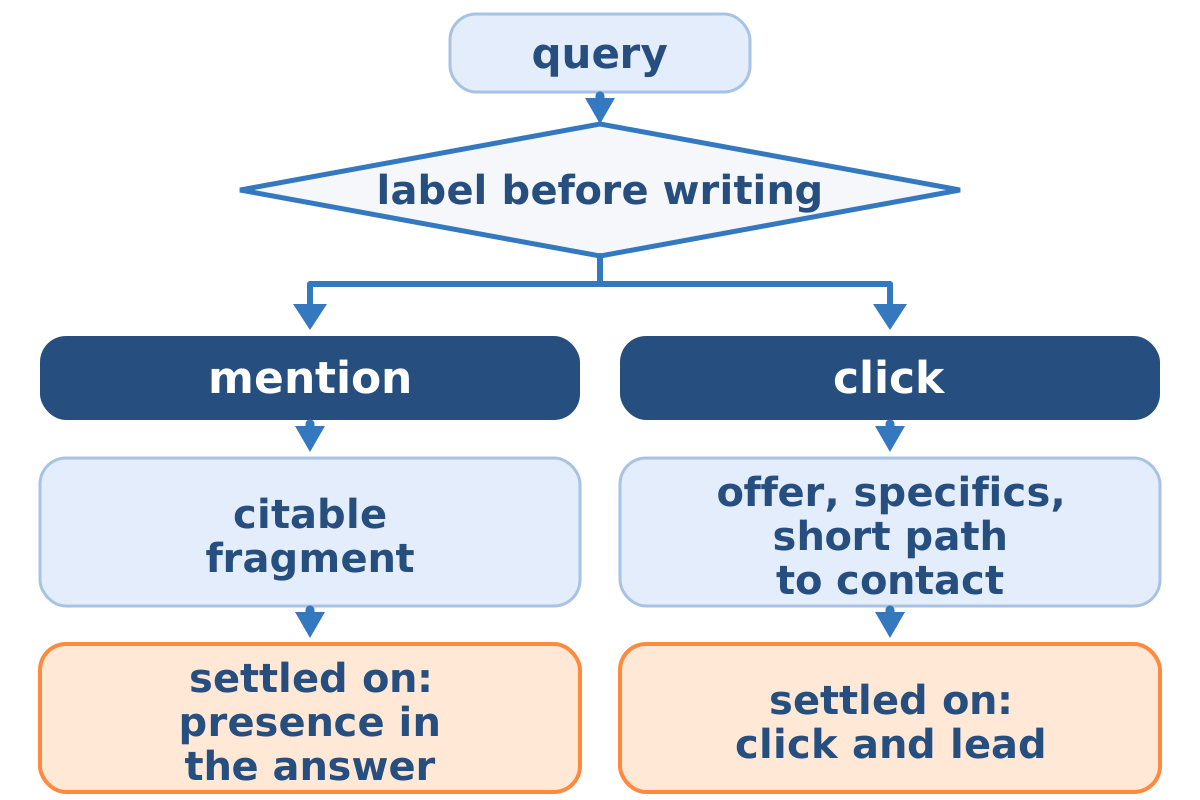
This split decides where a B2B company should put its effort. Informational queries are played for a mention; commercial queries are still played for a click and a lead.
A published analysis of the query set that triggers AI Overviews (Ahrefs, 2026) points in one direction: almost all of those queries carry informational intent — “what is”, “how to”, “how long does it take”. There, the AI answer eats the click: the user gets the explanation and does not visit the site. Queries with buying intent — “services”, “for companies”, “implementation”, a category name with a B2B qualifier — trigger the AI panel far less often, and the user goes to the site anyway, because they want to see the supplier.
Hence two games, run in parallel and by different means:
- Informational content → the game for a mention. It stays in the plan, but it settles against presence in the answer, not against a click. The job of such a text is to be citable: to contain a fragment the model can take whole, and to carry something the other ten sources do not have.
- Commercial content → the game for a click and a lead. A service page, a segment page, a page with proof. This is won the way it has always been won: a clear offer, specifics, and a short path to contact.
In the drySEO laboratory this difference collapses into a single editorial rule: before a text is written, the query gets the label “mention” or “click”, and the structure, the length and the settlement method follow from the label. The same rule governs the whole commercial layer described on our SEO and SEM services.
Can ChatGPT do SEO for you?
Partly — and the limit is not the quality of the model, it is what SEO work is made of. A model executes the bounded tasks well and owns none of the decisions.
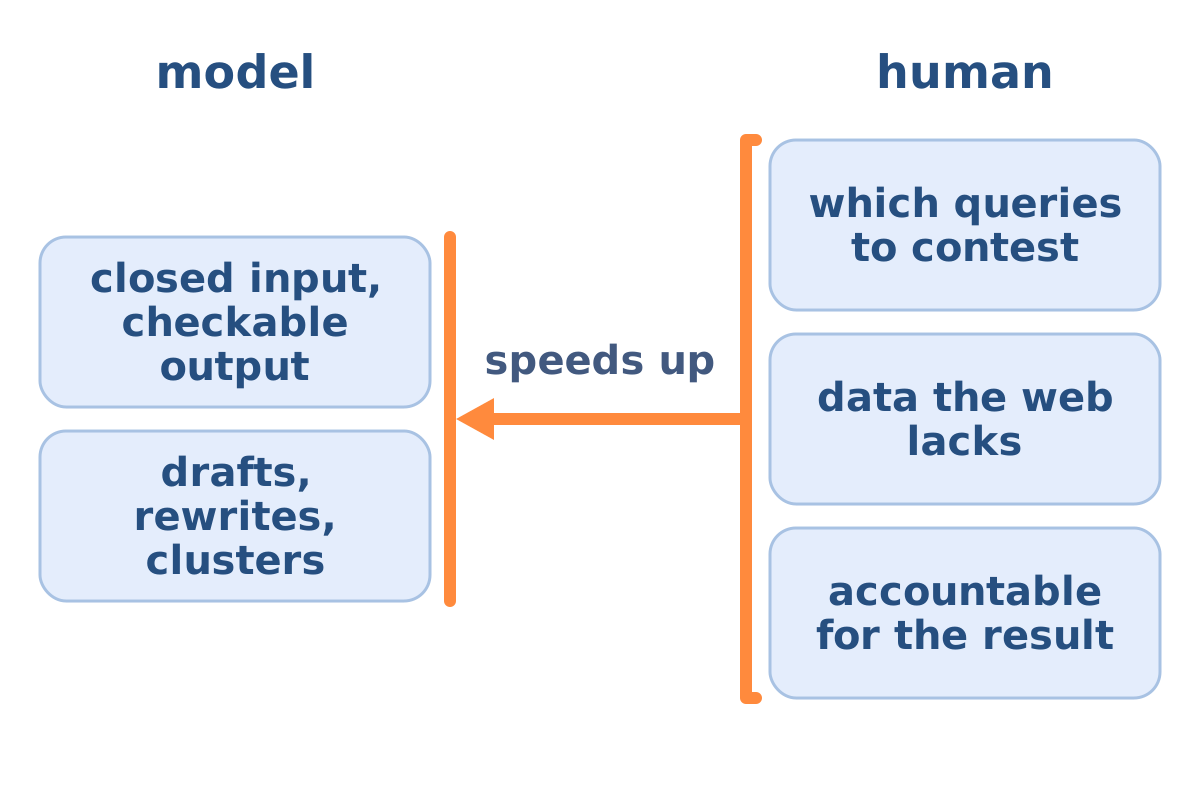
A language model performs well on tasks with a closed input and a checkable output: drafting an outline from a collected term set, rewriting a paragraph, generating title variants, clustering a keyword list, a first pass at intent classification, reviewing a text for repetition. That is a genuine saving of hours, and a company that refuses it is paying for typing.
What the model does not do for you:
- it has no access to your data — to your analytics, campaign costs, CRM, and to the record of which queries turned into orders; without that, every recommendation it gives is generic by construction;
- it does not know your competitive position beyond what it finds in public text, and the decision about which queries are worth contesting at all is a business decision;
- it contributes no unique data — and unique data is today the main fuel of mentions, because a model picking a source to cite picks what it cannot find elsewhere;
- it carries no consequence — accuracy of the choice, consistency of implementation and honest measurement stay with a person.
A sane division of labour looks like this: the model accelerates execution, the human decides direction and supplies what the internet does not yet contain. A site assembled entirely from generated text with no proprietary input is indistinguishable from dozens of others — and a model choosing whom to quote distinguishes.
There is a second-order effect worth naming. Because models are cheap to run, the volume of adequate content is rising fast, and the scarce good is no longer fluency. It is evidence: a measurement, a denominator, a date, a case with numbers attached. That is what raises a fragment out of the candidate pool.
How to build content an AI model can cite
Citation happens at the level of the fragment, so the text is designed out of fragments.
Heading = question, first paragraph = the full answer
The opening sentence of a section answers the heading with no run-up. A model that lifts that paragraph alone must find a closed meaning inside it.
Atomic sections
One section settles one thing. A fragment that points “as described above” loses its meaning the moment it is cut out.
Evidence next to the claim
A number, its denominator, a date, the conditions of measurement. A claim with no evidence is one candidate among a thousand.
Consistent brand facts across the web
The same name, the same scope of activity, the same authors on the site, in profiles and in other people's texts. A discrepancy in those facts reads to a model as uncertainty.
Machine-readable structure
A table instead of a description of a table, a list instead of an enumeration buried in a compound sentence, data expressed in markup.
Proprietary data as leverage
Your own measurement, your own comparison, your own case. It is the one kind of content a model will not find at a competitor — and the shortest route to a mention.
How do you measure the effectiveness of AI SEO?
In three layers at once: brand presence in answers to a fixed prompt set, referral traffic from AI engines, and the outcome on the lead. None of the three is sufficient alone, and the last one is binding — the first two can be produced without touching the sales system, which is exactly what makes them easy to report and hard to act on.
The layers, from the least to the most binding:
1. Presence in answers
You fix a set of several dozen prompts your customers actually ask, and you run them on a cycle across several engines — Google AI Overviews, the AI mode, ChatGPT, Perplexity. You record whether the brand appeared, in what context, and alongside whom. The result is a share of mentions across a fixed prompt set, tracked over time. The set has to stay fixed, otherwise there is nothing to compare; the prompts have to come from customers, not from a brainstorm.
2. Referral traffic from AI engines
In analytics you separate the sources that correspond to AI engines and treat them as a channel of their own. The volume will be small — that is normal and it is not a measure of failure, because in this game the click is not the objective. It is, however, a good quality indicator: sessions arriving from AI engines usually show a markedly different depth than traffic from classic search.
3. The outcome on the lead
The deciding layer. Visibility in AI earns its place when it turns into a commercial enquiry — and here the same measurement discipline applies as in advertising. Count the enquiries attributed to this layer under the same denominator you use for every other channel, and write that denominator next to the figure. Without it the layer produces a number that cannot be compared with last quarter, which is the only comparison that settles whether the work paid.
Two figures from the drySEO laboratory show why that discipline is not a formality:
- The cost of acquiring a lead from advertising, within one account and one period, is PLN 73, PLN 237 or PLN 452 — depending on whether the cost is divided by all leads from the foreign markets served, by leads carrying a campaign parameter, or by the conversions counted in the ad panel. The 6.2× spread is definitional, not a market effect: one phenomenon counted with three denominators (drySEO lab data).
- The ad panel under-reports conversions by 1.4–1.9× — leads carrying a campaign parameter and found in the CRM, divided by the conversions counted in the panel. The direction is one-sided: the panel always sees fewer (drySEO lab data).
If that is how measurement behaves in a channel that has its own panel and its own tracking parameters, then a measure of AI visibility — indirect by nature — needs its denominator stated all the more. A metric without a denominator is not a result, it is a number. The full method of setting denominators before the first report is described in the cost guide.
AI SEO in a B2B company: from visibility to a sales enquiry
Assembled into a sequence, work on AI visibility in a B2B company looks like this:
Split the queries
into informational (the game for a mention) and commercial (the game for a click and a lead).
Technical and entity hygiene
crawlability, headings, consistent company facts on the site and off it.
Rebuild informational content for citation
atomic sections, the answer up front, evidence beside the claim.
Introduce proprietary data
a measurement, a comparison, a case. This is the lever for mentions and simultaneously the one kind of content that cannot be copied.
Maintain the commercial layer
the pages this traffic is meant to land on, because that is where a sales enquiry is created.
Measure in three layers
and settle on the lead.
Steps 1–4 belong to the channel. Step 5 is where the channel meets the outcome it is run for: visibility turns into a lead on the landing page, not inside the model's answer. That is why AI SEO runs as one channel among several within B2B SEO, settled against the same outcome as the rest.
Frequently asked questions about AI SEO
Is SEO still worth it when AI answers for the user?
It is, but the target moves. On informational queries you compete for presence inside the answer; on buying queries you still compete for the click and the lead, because that is where the user wants to see a supplier. The technical foundation stays common to both games, which is why the work compounds rather than splits.
What is the difference between AI mode and AI Overviews?
AI Overviews is a generated answer placed above the classic results — the list of ten links remains underneath. AI mode is a separate interface in which a conversation replaces the result list and follow-up questions are possible. The optimization principle is the same in both: a citable fragment that answers a sub-query.
Do hosting, the domain or the certificate affect visibility in AI?
They affect it the same way they affect classic SEO — indirectly, through availability and speed. Worth checking separately: whether the protective layer in front of your site allows the crawlers of AI engines through, because some configurations block them by default and the page drops out of the candidate pool for citation despite correct content.
How long before results show?
First mentions across a prompt set usually appear sooner than organic traffic, because a model does not need domain history — it needs a fragment it can quote. Stable presence is the slower part: a prompt set measured on a cycle shows a trend only after several readings.
Will AI replace SEO specialists?
It redraws the division of labour: execution accelerates, while the weight of decisions and of proprietary data grows. The scarce skills move toward choosing what to measure, supplying data the internet lacks, and reading whether a change actually worked.