
Lead generation for law firms is the work of producing enquiries from people and organisations who need legal representation, and of handling those enquiries well enough that they become instructions. It follows the general mechanics of B2B lead generation, with one constraint that shapes everything: the profession is regulated, and the rules governing what a firm may say and what it may pay for are set by the bar or law society that admits its lawyers.
How do you generate leads for a law firm?
A law firm generates leads from four sources, and they differ in cost, control and speed: referrals, search, content, and paid channels including purchased leads. Most firms are heavily dependent on the first and under-invested in the second.
Referrals
remain the strongest source in legal services, because the decision involves handing a stranger a problem that matters. A recommendation from a former client, an accountant, a financial adviser or a lawyer in an adjacent specialism arrives with the trust already established. Referral generation is a process rather than a mood: it requires a record of who has been served and who sends work, a reason to reappear that is useful to the recipient, and someone accountable for maintaining the relationships.
Search
is where people take a legal problem when they have nobody to ask, which is most people, most of the time. Two elements carry it: coverage of the queries that combine a specialism with a location, and a complete, well-reviewed business profile that appears in local results before any website does. For a firm with one or two offices this pair outperforms a large generic site.
Content
occupies the period between the problem appearing and the firm being chosen. Clear explanations of the situations clients actually find themselves in — written for someone frightened and uninformed rather than for another lawyer — build both search visibility and the confidence to make contact. The firm that explained the problem is the firm that gets the call. How that traffic becomes a commercial enquiry is set out in our SEO leads guide.
Paid channels
buy immediate visibility and stop when the spend stops. They include advertising and, in some markets, the purchase of leads from third-party providers, which raises questions the other three do not.
What are the ethical considerations when paying for leads?
Paying for legal leads raises questions that apply to no other industry on this site, and they have to be resolved against the firm's own regulator before any budget is committed. The rules differ materially between jurisdictions, so the useful contribution here is the structure of the decision rather than an answer.
Three questions decide whether an arrangement is viable:
What exactly is being paid for?
Advertising that produces enquiries is treated differently from an arrangement in which payment is tied to matters actually obtained. This distinction is the one most commonly at issue.
Who appears to be recommending the firm?
A directory that lists firms and a service that appears to endorse one occupy different positions, and the second attracts more scrutiny.
What does the client see?
Requirements about disclosure, about who is responsible for the advertising, and about claims of expertise or outcome attach to the communication itself.
The practical instruction is unavoidable and worth stating plainly: confirm the position with the admitting bar or law society before signing, because the cost of an arrangement that breaches professional conduct rules is a disciplinary matter rather than a wasted budget. The separate question of data protection and marketing law — consent, email rules, cookies, records — applies to law firms exactly as it applies to everyone else, and is covered in the consent and list-building rules for cold email.
What are the pros and cons of buying legal leads?
Buying legal leads converts marketing budget into enquiries immediately, and the trade-off is control: over quality, over exclusivity, and over the impression the client formed before arriving.
The case for buying is speed and predictability. A new practice area, or a firm entering a city, can have enquiries this month rather than next year, and the cost per enquiry is known in advance.
The case against is that purchased leads are frequently shared with several firms at once, which turns the first conversation into a race rather than a consultation; that the enquirer may have been qualified against criteria the firm did not set; and that the firm inherits whatever the provider said to obtain the contact. The test that matters is therefore not cost per lead but cost per instruction, which is what makes exclusive leads affordable at prices that look high per contact — and which requires the measurement described further down this page.
What is the 80/20 rule for lawyers?
The 80/20 rule is the Pareto heuristic applied to a practice: a minority of matter types, clients and referral sources produces the majority of revenue. It is a heuristic rather than a measured ratio, and its value lies in prompting a firm to measure its own distribution instead of assuming a number.
Applied to lead generation the instruction is concrete. Rank matter types by contribution rather than by volume; rank referral sources by instructions produced rather than by enquiries sent; then direct content, search coverage and relationship time toward whatever the ranking reveals. Most firms discover that their marketing effort is distributed evenly across a practice whose revenue is not.
What is legal client intake, and why does it decide the result?
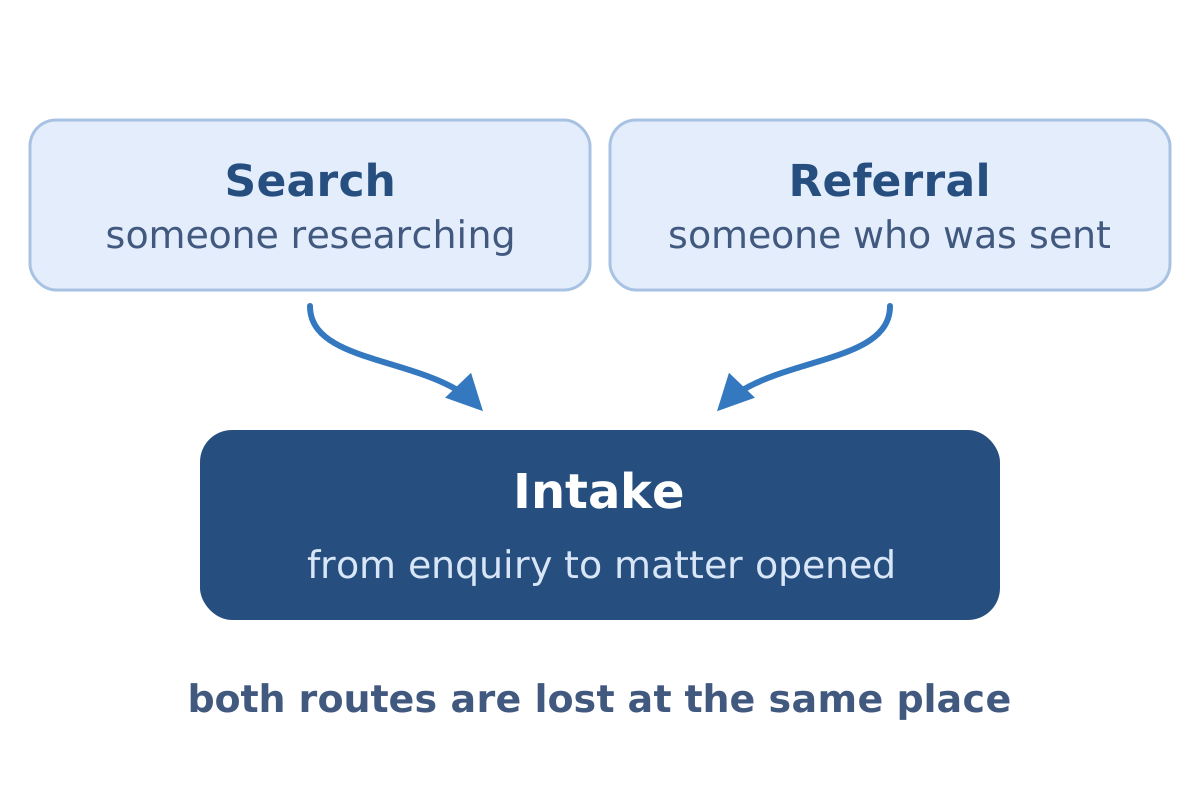
Client intake is the process between an enquiry arriving and a matter being opened, and it is where most law firm marketing budget is actually lost. A firm can fix its visibility, double its enquiries and see no change in instructions, because the constraint was never visibility.
Four things make intake work. Enquiries route to a named person rather than to a shared inbox. First response happens while the enquirer is still engaged with the problem that prompted them to write. A single record per contact holds source, history and next action, so that nothing depends on whose phone received the call. And conflicts and viability are checked early enough that time is spent on matters the firm can take.
An observation from drySEO lab practice bears on the last stage: conversion of a new client typically follows the fifth contact, with sequences running to twelve follow-ups. This is directional — a pattern from inbound B2B experience, distinct from the measured figure below, which carries a denominator. A firm whose process ends after one unanswered call is stopping well short of where the work converts. The systems that carry a cadence of this kind are covered in the marketing automation guide.
How do you measure law firm lead generation?
Law firm lead generation is measured on enquiries by source and on the share of each source's enquiries that become instructions, with the denominator stated every time. The second number is what makes the first meaningful: a source producing many enquiries and few instructions is a cost centre wearing the costume of a success.
One measurement rule transfers from technical B2B work and changes budget decisions. Advertising panels report only what they can attribute, and in drySEO lab data the comparison of enquiries carrying a campaign parameter in the CRM against the panel's own conversion count gives a ratio of 1.4–1.9×, always in the same direction: the panel sees fewer (denominator: campaign-parameter leads in the CRM ÷ conversions reported by the panel; a control from a third system agreed within 0.4 percentage points; drySEO lab data, measured on a B2B inbound account). Treat the panel figure as a floor and reconcile it against the system where matters are recorded. The definitions that make such a reconciliation possible are set out in the lead conversion guide.
How does a firm improve its lead conversion rate?
A firm improves conversion by shortening the distance between the enquiry and a useful answer, at three specific points.
At the page. The specialism, the location, the person who will handle the matter and the way to reach them appear without scrolling. A prospective client in difficulty abandons a site that hides its phone number in the footer.
At first contact. The first exchange answers the question that was asked. Scheduling comes after substance, because the enquirer is deciding whether this firm understands their situation.
At follow-up. A defined sequence keeps the matter open through the period in which the client is deciding whether to act at all, which in legal services is frequently longer than the firm assumes.
Building the search coverage, content and measurement that support all three is the work described in our SEO and SEM services.